Camden Market History: From 1974 to London’s Cultural Landmark
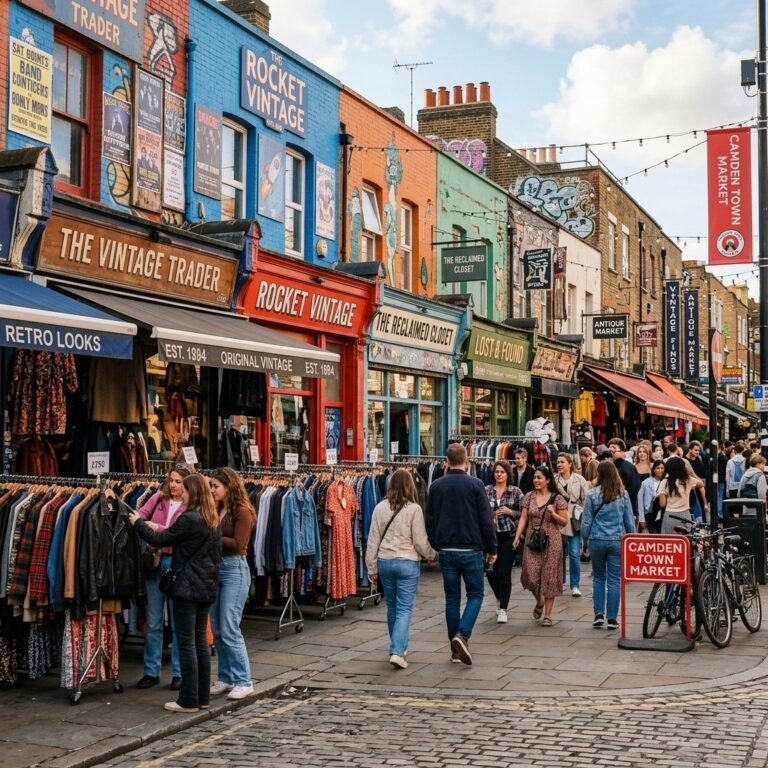
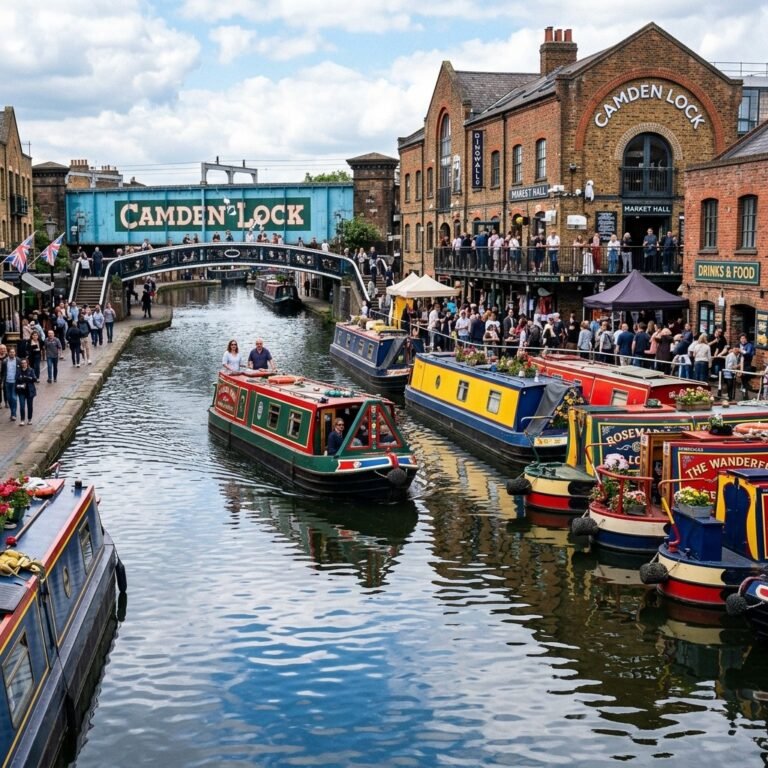
Camden Market history began on March 30, 1974, when 16 traders opened a Sunday crafts market in a former timber yard beside Camden Lock. Built on a Victorian industrial site once home to Pickfords’ horse stables, the market grew into six sub-markets now drawing roughly 250,000 visitors weekly, making it London’s fourth-most-visited attraction.
Most visitors weaving through Camden Market’s stalls today have no idea they’re walking over horse tunnels, former gin warehouses, and the site of a bombing that made national news. Camden Market’s story isn’t just about market stalls and vintage jackets it’s a tale of industrial decline, punk rebellion, cultural icons, and a very modern billion-pound property saga.
History of Camden Market: What Was Camden Like Before 1974?
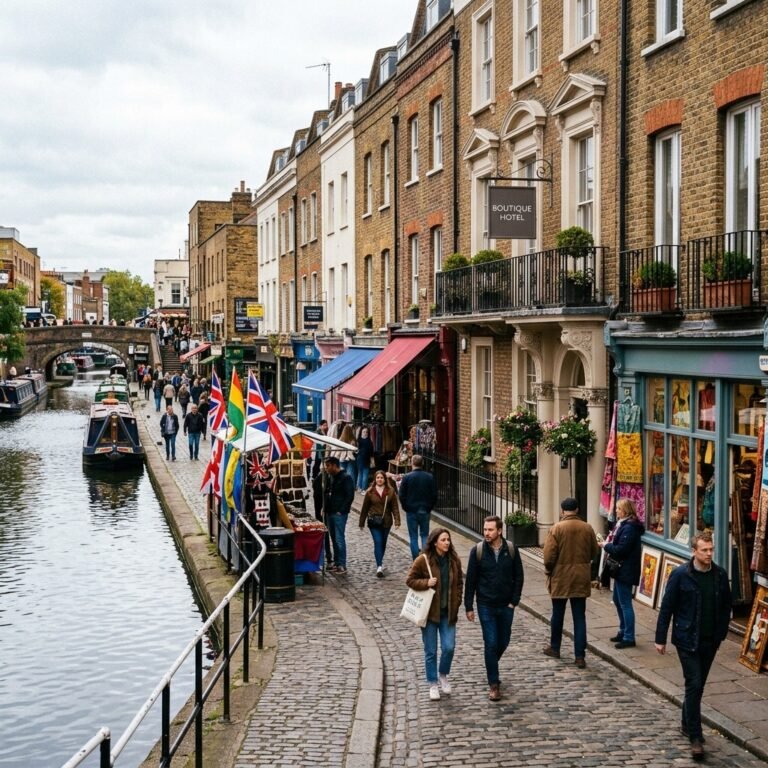
Before Camden Market existed, the area was one of London’s busiest industrial transport hubs, built around the Regent’s Canal and the London & Birmingham Railway Britain’s first intercity line. Hundreds of working horses, stabled by the removals firm Pickfords, moved goods between canal barges and railway wagons daily.
Camden’s transformation began in 1816, when construction of the Regent’s Canal reached the area from Paddington, turning Camden into a canal terminus complete with basins, warehouses, and an 80-foot ice well. By the 19th century, wine and spirits importer W&A Gilbey had moved its business to Camden Goods Station, and the area became famous worldwide for gin production.
Camden’s Victorian workhorse economy, at a glance:
| Feature | Detail |
| Working horses | Around 800 stabled in the marshalling yards |
| Horse hospital | More than 800 horses treated in 1939 alone |
| Last horse retired | 1967 |
| Stable operator | Pickfords |
| Canal reached Camden | 1816 |
The horses moved goods between the canal and rail line through a network of underground tunnels safer than crossing the busy yards above. By the late 1960s, road haulage had replaced horse and canal transport almost entirely, and Camden’s once-thriving industrial buildings sat empty and derelict. That vacancy created an unlikely opportunity.
Camden Market 1974: How Did It All Begin?
Camden Market opened on March 30, 1974, when 16 traders set up stalls selling antiques, jewellery, and crafts in the old T.E. Dingwall builders’ yard beside Camden Lock. Trading was Sunday-only at first, taking advantage of a derelict site that was otherwise scheduled for demolition to make way for a planned urban motorway.
The location was almost accidental. Plans for the North Cross Route, a motorway intended to cut straight through the site, meant permanent redevelopment was off the table. That left a temporary market as one of the only viable uses for the abandoned yard. When the motorway plans were scrapped in 1976, Camden Lock Market had already become a fixture of the area.
Key facts about the 1974 opening:
- Location: former T.E. Dingwall builders’ yard beside Camden Lock
- Number of original traders: 16
- Goods sold: antiques, jewellery, arts and crafts
- Trading days: Sundays only, initially
- Early trader: designer Wayne Hemingway was among those who sold at the market in its formative years
Late 1970s–1980s: How Did Sunday Trading Laws Turn Camden Into a Shopping Destination?
Camden Market’s early growth was driven largely by outdated Sunday trading restrictions, which barred most shops from opening on Sundays but didn’t apply to market stalls. That loophole made Camden one of the only places in London where shoppers could browse on a Sunday, and the crowds followed.
Trading expanded rapidly through the early 1980s. By 1985, market stalls had spread along and around Chalk Farm Road, and three additional markets had opened: the Stables Market (built inside the former Pickfords horse stables), Camden Lock Village, and the Electric Ballroom market.
This period also marked the start of Camden’s identity as a hub for alternative culture. Punk bands rehearsed in buildings that would later become fixtures of the market, including the space that eventually housed the alternative fashion store Cyberdog. Camden was no longer just somewhere to buy a secondhand jacket it was becoming a cultural landmark.
What Made the 1990s Camden Market’s Golden Era?
The 1990s cemented Camden Market’s reputation as the epicenter of British alternative culture, driven by the Britpop explosion, a permanent indoor market hall, and the area’s deepening links to music legends like Blur, Oasis, and Madness. It was also a decade marked by tragedy, with an IRA bombing on Camden High Street in 1993.
In 1991, a three-storey indoor market hall designed by architect John Dickinson in a style echoing the area’s 19th-century industrial buildings opened on the site of the original outdoor market. Built from brick and cast iron, it gave Camden Lock a permanent, weatherproof home for the first time.
Notable 1990s milestones:
- 1991: Three-storey indoor Camden Lock hall opens, designed by John Dickinson
- 1993: A Provisional IRA bomb hidden in a litter bin explodes on Camden High Street on February 28, injuring 11 people
- 1994: The Sunday Trading Act ends the legal loophole that had fueled Camden’s Sunday shopping boom, forcing the market to compete on merit rather than opening hours
- Britpop bands, ska revivalists, and reggae acts turned Camden’s pubs and venues into some of the most important music spaces in the UK
- Alternative fashion goth, punk, and grunge influenced became permanently associated with Camden’s stalls
Despite losing its Sunday monopoly, Camden’s cultural momentum by this point was strong enough to carry it into the next decade.
How Did Amy Winehouse Shape Camden Market’s Cultural Peak?
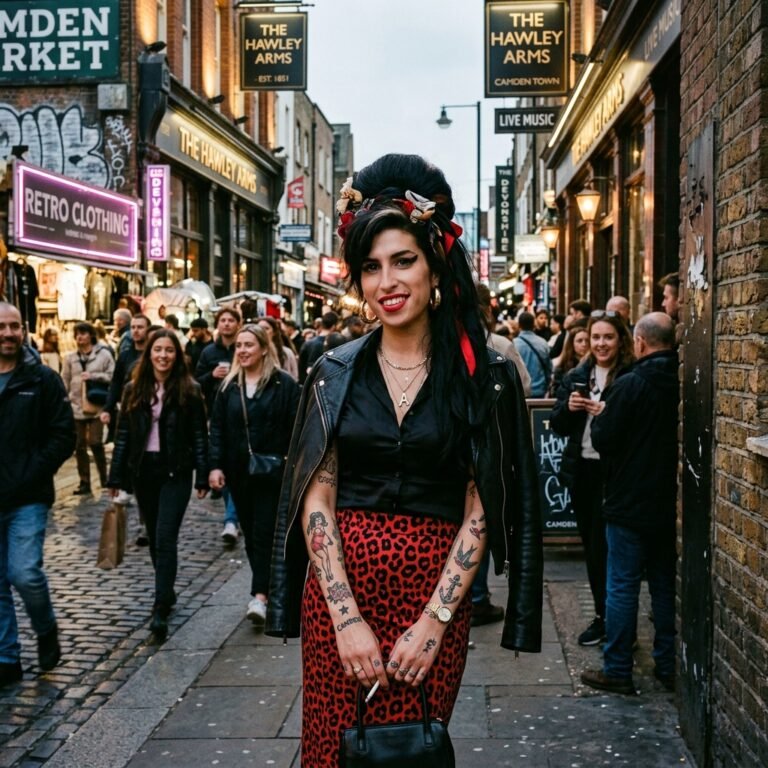
Amy Winehouse worked at Buck Street Market and Camden Lock as a teenager before becoming one of Camden’s most famous residents, cementing the area’s identity as the heart of London’s music scene throughout the 2000s. She was a regular at the Jazz Cafe, Dublin Castle, and the Hawley Arms.
This decade also brought major physical changes to the market. In 2006, a large indoor hall was constructed in the yard between Camden Lock Market and the Stables Market, previously used only for open-air stalls. Two years later, in February 2008, a devastating fire tore through the Canal Market, badly damaging the rear of the Hawley Arms pub in the process.
Winehouse referenced the fire in her acceptance speech at the 2008 Grammy Awards, telling the audience: “This is for Camden, Camden Town ain’t burning down.” The line became one of the most quoted moments linking Camden’s music culture to the market itself.
How Did the LabTech Era Transform Camden Market in the 2010s?
The 2010s brought Camden Market under single corporate ownership for the first time, after Israeli billionaire Teddy Sagi’s company LabTech acquired the Stables Market and other major sections in 2014 for a reported $685 million. This decade also saw Amy Winehouse‘s death, a major fire, and the start of large-scale redevelopment.
Amy Winehouse died on July 23, 2011, at her home on Camden Square, aged 27. Three years later, on September 14, 2014, a bronze statue of her was unveiled in Camden’s Stables Market the same year LabTech completed its major acquisition.
2010s timeline:
| Year | Event |
| 2011 | Amy Winehouse dies at 30 Camden Square, age 27 |
| 2014 | LabTech acquires Stables Market and other sections for a reported $685 million |
| 2014 | Amy Winehouse statue unveiled in the Stables Market |
| 2016 | Urban Markets Company acquires Camden Lock for £300–400 million |
| 2017 | Fire breaks out at Camden Lock Market on July 10; around 70 firefighters and 10 engines respond |
| 2019 | Buck Street redeveloped as a shipping-container market, built from 88 recycled units |
Under LabTech, Camden shifted from a patchwork of independently owned stalls toward heavily developed, permanent structures a trend that would define the market’s next chapter.
What Does Camden Market Look Like in the 2020s?
Camden Market in the 2020s has continued its transformation into a permanent, mixed-use destination, highlighted by the £500-million-plus Hawley Wharf development, the sale of the Buck Street site to Transport for London in 2023, and its 2024 relaunch as Boxpark Camden.
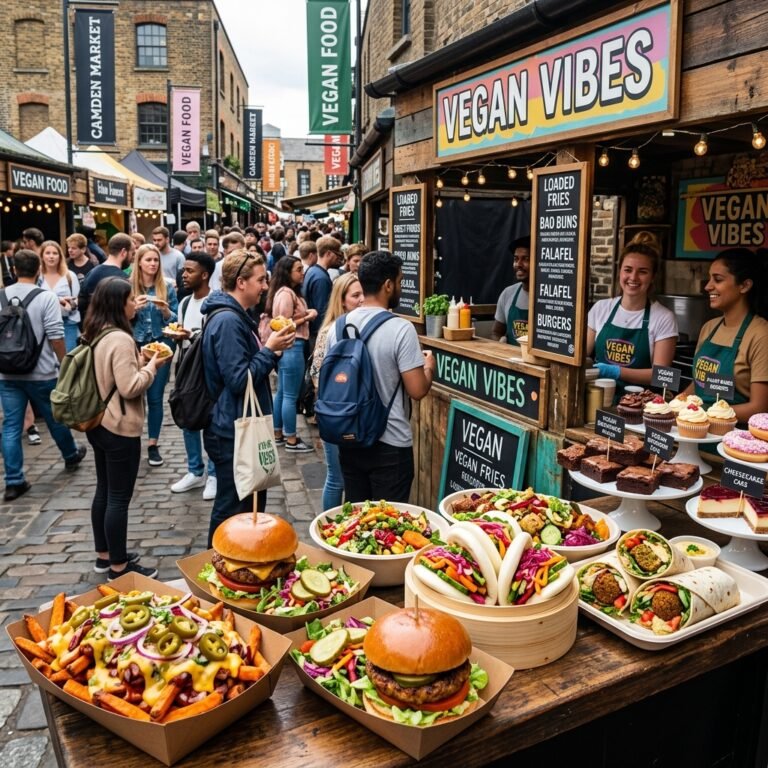
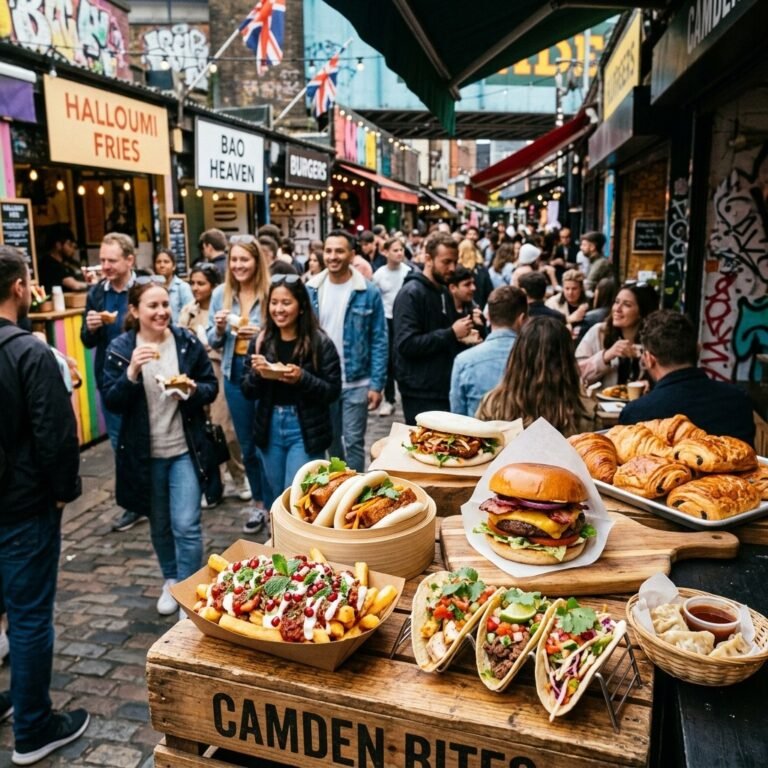
Hawley Wharf, built on the site of the old Canal Market, began opening in 2021 after years of redevelopment. The four-storey complex added roughly 60 food vendors, 150 shops, co-working space, and 200 homes to the area a scale of development previous decades never saw.
Recent developments:
- 2021: Hawley Wharf opens in stages, including the Curzon Cinema and Waterside Halls dining hall
- 2022: LabTech puts its Camden Market holdings up for sale, seeking around £1.5 billion
- 2023: Transport for London’s property arm, Places for London, acquires the Buck Street site to help fund upgrades to the overcrowded Camden Town Underground station
- 2024: Boxpark takes over management of the Buck Street site, rebranding it as Boxpark Camden
- Camden continues to attract an estimated 250,000 visitors per week, making it London’s fourth most popular visitor attraction
What Are the Pickfords Horse Tunnels Under Camden Market?
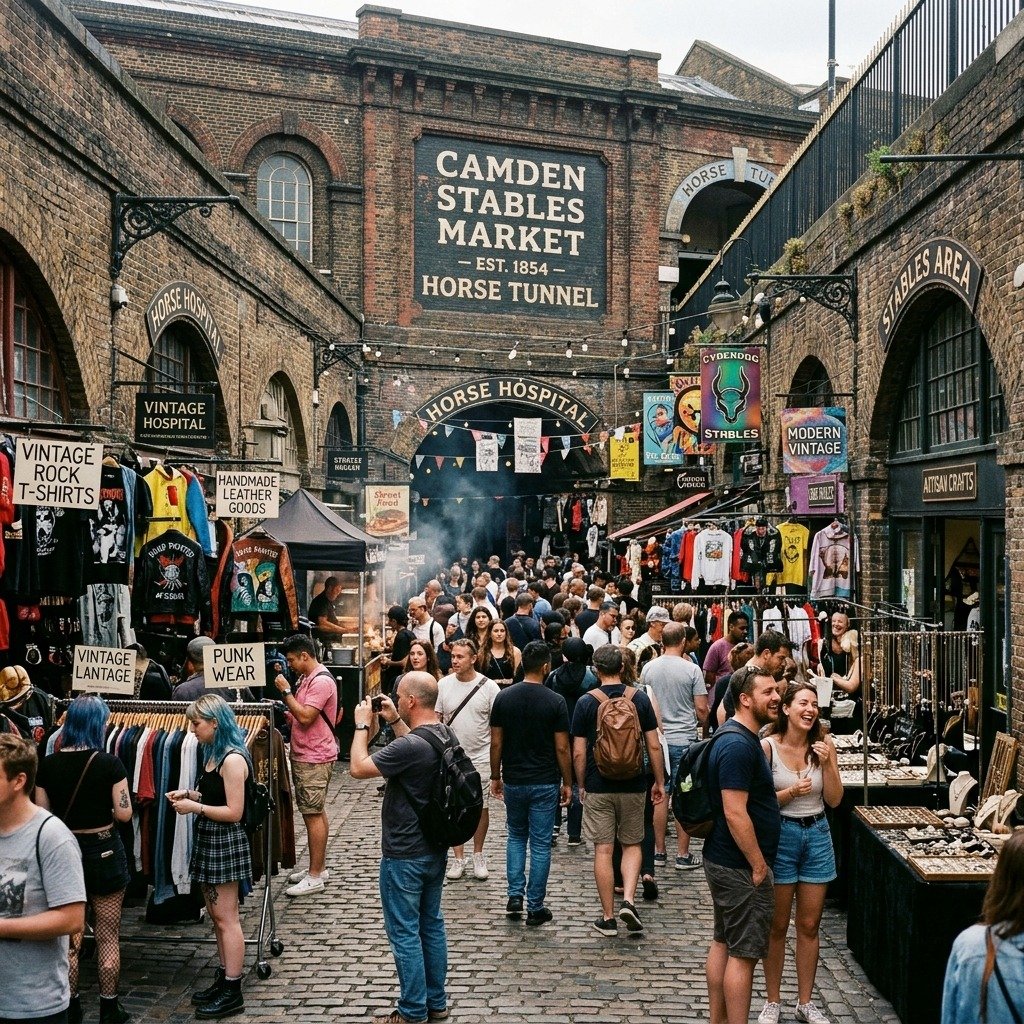
The Pickfords horse tunnels are a network of underground passageways built beneath Camden in the 19th century to let working horses move safely between the Regent’s Canal and the railway lines, without crossing the busy goods yards above ground. Part of the network survives today as the Horse Tunnel Market within the Stables Market.
Engineer Robert Stephenson built the tunnels alongside underground engine vaults that once housed the winding gear used to haul trains up the incline from Euston to Camden by rope. In 1869, wine importer W&A Gilbey began using sections of the vaults to store whiskey, wine, and gin, giving the network a second life as a subterranean warehouse.
Fast facts on the horse tunnels:
- Built by engineer Robert Stephenson in the 19th century
- Connected the Roundhouse to the Regent’s Canal
- The Stables Market building itself is Grade II listed, along with its horse hospital
- Much of the wider tunnel network nicknamed the “Camden Catacombs” remains submerged in water and closed to the public today
- A visible section survives as the Horse Tunnel Market inside the Stables complex
Who Owns and Manages Camden Market Today?
Camden Market’s four main sections were originally owned separately by different landlords before Teddy Sagi’s company LabTech began consolidating ownership in 2014, eventually controlling most of the site. The Buck Street section is now a notable exception, owned by Transport for London since 2023 and managed by Boxpark since 2024.
Ownership at a glance:
| Section | Owner/Manager | Since |
| Stables Market | LabTech (Teddy Sagi) | 2014 |
| Camden Lock Market | Urban Markets Company | 2016 |
| Hawley Wharf | LabTech (Teddy Sagi) | Redeveloped from 2015 |
| Buck Street (Boxpark) | Places for London (TfL) / Boxpark | 2023 / 2024 |
In 2022, LabTech put its Camden Market holdings up for sale through Rothschild & Co, seeking a price of around £1.5 billion a figure that reflects how far the market’s value has climbed since 16 traders first set up stalls for £0 rent in a condemned timber yard.
What Does Camden Market Mean Today?
Camden Market remains one of London’s most visited attractions, drawing around 250,000 people each week across six connected sub-markets, while holding onto a defining rule from its earliest days: chain stores are not permitted. That policy has helped preserve Camden’s identity as a home for independent traders even as ownership has consolidated.
- Over 1,000 independent stalls, shops, and food traders operate across the site
- No chain stores are allowed, a rule that has held since the market’s early expansion
- The Stables Market’s horse hospital and stable buildings hold Grade II listed status
- Camden’s radio station, CDNX, broadcasts indie, rock, and classic dance music in partnership with XFM founder Sammy Jacob
Camden Market has changed hands, burned down twice, and been rebuilt in concrete and steel yet the atmosphere that first drew crowds away from Sunday-shuttered high streets in the 1970s is still what pulls people through the gates each week.
Frequently Asked Questions
When did Camden Market open?
Camden Market opened on March 30, 1974, when 16 traders began selling antiques, jewellery, and crafts in a former builders’ yard beside Camden Lock.
Who owns Camden Market?
LabTech, a company controlled by Israeli billionaire Teddy Sagi, has owned most of Camden Market’s major sections since 2014. The Buck Street site is a separate exception, owned by Transport for London since 2023.
What was on the site of Camden Market before it became a market?
The site was a Victorian industrial hub built around Pickfords’ horse stables, a canal terminus, and gin warehouses, serving London’s rail and canal freight trade until the 1960s.
When did the Camden Lock indoor hall open?
The three-storey Camden Lock indoor market hall opened in 1991, designed by architect John Dickinson in a style echoing 19th-century industrial buildings.
Has Camden Market ever had a fire?
Yes. Fires struck the Canal Market in February 2008, the Stables Market in May 2014, and Camden Lock Market in July 2017, the latter requiring around 70 firefighters to bring under control.
How much did Camden Market sell for in 2014?
LabTech acquired the Stables Market and other major sections in 2014 for a reported $685 million, marking the start of single-ownership consolidation across the site.
What’s the oldest sub-market at Camden?
Inverness Street Market has operated since the late 19th century, making it Camden’s oldest, though Camden Lock Market (opened 1974) is the origin of the modern Camden Market complex.
Are the Camden horse tunnels still there?
Yes. Part of the 19th-century horse tunnel network survives as the Horse Tunnel Market inside the Stables Market, though most of the wider tunnel system remains flooded and closed to the public.
Did an IRA bomb explode at Camden Market?
Yes. On February 28, 1993, a Provisional IRA bomb hidden in a litter bin exploded on Camden High Street near the market, injuring 11 people.
What happened to Buck Street Market?
Transport for London’s property arm acquired the Buck Street site in October 2023 to help fund Camden Town Underground station upgrades. Boxpark took over management in 2024, rebranding it as Boxpark Camden.